
Behind these eyes
A child cries
Brick hands reaching to be held
The sun’s gazes through the curtain
Melting, scorching, pealing
A womb within a room on the edge of doom
Fleeting, fleeting, repeating
Eyes open
A cry of despair when there is no one there to care
Crash, crash, crash
Where did you stash it? Where did you stash it?
Show me! Show me! Show me!
Who are you?
Who are you?
Who are you?
. . .
Broken hearts
Broken toys
Girls and boys
Lost within the noise
Hold me
Find me
Forgive me
Love me
The blur between
Red and blue
Hell will find you
When I was five I knew I was Queer after I picked up one of my sister’s dolls. I barely moved it and a crashing wave of judgment swallowed my whole being. I quickly gave the doll back to my sister. Society’s long overreaching hand had found me. I had broken the rules of boyhood. That was the day I learned how to hide.
At what age did you know you were Queer? When did you recognize your otherness?
It is evident that for most of our childhood, we have to hide. We dedicate most of our early years to passing as Heterosexual and concealing our Queer identities, both physically and socially. We feel a sense of otherness from an early age but may not be fully aware of its name. We can ostensibly refer to these stages of our development as “Queerhood.”
Queerhood can arguably be defined as a set of experiences and stages of development that are especially unique to those who identify as LGBTQIA+. We already categorize the early stages of development from infancy to adolescence within the gendered paradigms of boy and girl – boyhood and girlhood. The same can essentially be applied to “Queerness.”
Don’t we, as LGBTQIA+ individuals, have a set of unique but also collective experiences? Whether Non-binary, Cis, Intersex, Trans, Lesbian, Gay, Bisexual, or A-sexual, this group experiences childhood differently.
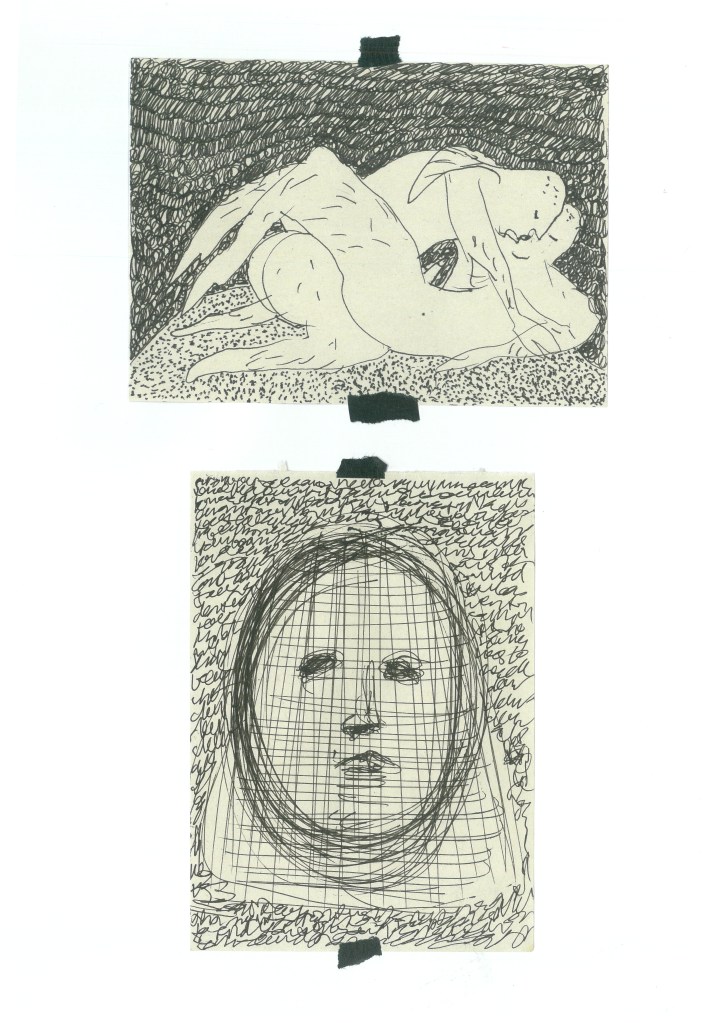
Throughout my childhood, I expressed a joy and passion for two things, drawing and monsters. I would spend hours and hours drawing and watching horror movies. Horror movies and drawing became a resource of freedom but also a space, a jungle, and an ocean ripe for exploration. The conjunction of horror and Queerness is a topic that has been examined, dissected, and conceptualized many times before but what about drawing?
What is drawing?
Drawing can traditionally be defined as using dry mediums such as charcoal, pens, pencils, or crayons on a surface, and traditionally the surface would be paper.
My own personal definition of drawing is “ to make contact” or “to transfer.”
Drawing, like writing, can be an act of intimacy. The function of a diary is often to capture and process our intimate thoughts and mundane experiences. Indeed, drawing functions the same as a space where thoughts, experiences, desires, and longing materialize. Many Queer artists such as David Hockney, Salman Toor, Francis Bacon, and many others have hinted at or exposed their Queer experiences on canvas or through drawing.
Salmon Toor constructs memories and fantasy memories of Queerness and childhood within a homophobic culture. Toor’s work expresses freedom through Queer friendships and the vulnerability that lies within those freedoms. Personal symbols, nightmarish scenarios, and intimate landscapes are abundant within his canvas. His work allows us to observe an intimate world of the queer experience, an experience of freedom, intimacy, and Innocence contrasted with violence, intimidation, and the disempowerment of homophobia. Toor’s work is a mutation of memory, observation, and fantasy. We observe surreal yet familiar landscapes and scenarios of the Queer experience.
Painting and drawing have undercurrents of our psychology. We process and navigate thoughts in these processes that may not be completely clear to us. Often artists later in their career reflect on their previous work and have a better understanding of what they were communicating. Art therapy uses drawing as a tool to make new connections and allow repressed trauma to surface.
Read More:
- Navigating Intersectionality: Black Queer Feminism in China and South Africa
- Elephant in the Room: The True Scale of Suicide in South East Asia
- Graphic Dreams: China-Based Artist Reimagines Anime and Queer Beauty
Artists such as Tracey Emin approach their art with raw honesty and an eagerness to be vulnerable with the audience. Emin exposes her experiences and opinions on sex, relationships grief, and womanhood through drawing. She is more widely known for her mono-prints that are raw, intimate, and expose the human condition. In her early years, Emin was often criticized and labeled as “controversial.” I believe this criticism is from ignorance and an eagerness to dismiss her work.
Emin, in many lecturers and interviews, has collectively stated that honesty is a big part of her work. Her series of drawings centered around the topic of “abortion” was her attempt at reaching out to her audience who had experienced this procedure and the distress that followed.
“I know your pain”
By exposing your own experiences you potentially validate the experiences of others.
The borders of otherness become transparent.
Honesty and Vulnerability
I believe that Queer people struggle within society. Our community has always been subject to censorship or silence. How many times have you been told not to share your opinion? How often has your Queer experience been dismissed? How often have you concealed your identity at work?
How often have you been refused an opportunity to engage in an activity? How often have you been simply told to “shut up?”
This marks the next stage of Queerhood – “silence.”
…
…
…
…
Breathe
…
…
…
…

How can we find our voice within silence?
The documentary “ The celluloid closet” provides clear commentary on the conflict between censorship and Queer narratives. We understand from this documentary that many famous “hetero-normative” narratives have underlying and hidden Queer characters and plots.
Many Queer storylines were “straight washed” while many Queer narratives were hidden or layered through symbols and suggestion. Queerness became the dermis of censorship.
In May 1933, The German Institute of Sexual Science, which was dedicated to understanding sexuality, was famously destroyed by the Nazis. With its destruction, studies of queerness were destroyed ultimately erasing LGBTQIA+ history.
The movie “The watermelon woman” directed by Cheryl Dunye tackles issues surrounding Queer history by constructing a “mockumentary.” The story follows a young black lesbian filmmaker called Cheryl and her attempts to identify an actor whom she labels “the watermelon woman.” As the plot progresses we discover that “ The Watermelon Woman” is a lesbian actor called “Fae.”

Throughout the mockumentary, Cheryl struggles to find resources and information on Fae. The character of Cheryl longs to retrieve this information, and while she is pursuing the story of Fae she is arguably pursuing herself. The movie explores the struggles that the LGBTQIA+ community faces when sharing our stories and how we often don’t have access to stories that can validate our own experiences. The message of “The Watermelon Woman” is that sometimes we must construct our own stories and past for others to connect to because nobody else will.
It is evident from the types of stories and media that we have produced in our own community, that we struggle to have a voice. We struggle to be visible. Again I propose the question, how do we find our voice within silence? When we are subjected to silence, censorship, and resistance to our Queer voice, how do we communicate? We may be afraid to share; we fear the consequences of exposure. Often this communication does not reside in others but it is reflective. This is the seed for constructing and contacting inner worlds.
What is inside your inner world? What savage garden do you cultivate?

It has been well documented throughout art history that many artists have used drawing and painting to immerse, contact, and extract from the subconscious and otherworldly inner spaces. The surrealist movement was a collection of pioneers of experimental and Freudian approaches involving drawing and writing. Methodologies such as automatic writing and drawing, assemblage, collage, bulletism, and automatism among many others, are attempts to access, extract, and contact spaces we both inhabit and are also detached from.
The abstract artist Hilma Af Klint is famous for her early explorations of abstract art that pre-date the abstract and expressionism movement. Klint allegedly used abstraction as a form of spiritualism and was known to be involved in the spiritualism movement as well as having a fascination with the occult.
William Blake, a British artist, widely known for his religious paintings often spoke to otherworldly voices. His painting, “The Great Red Dragon and the Woman Clothed with the Sun” depicts scenes from revelations. Blake has been well documented as claiming that he heard voices from God, and these voices had a great influence on his aesthetic and the subject matter of his work.
Join the field
That reaps the plenty
Hands falling down
Reaching to be held
By golden orbs
Touch, kiss, whisper
I can no longer see your nose
How will I ever find you again?
Ice, ice, stretch
Crack, bend, snap, break
1
1
1
9
Today is an old day
How could I ever forgive the bars
That hold me
Maybe if they said “please”
I don’t hold hope for long
Hold me
Forever
How can we use these drawing approaches to discover and immerse ourselves in our Queerness? I personally believe in engaging in the basic functions of drawing – “contact” and “transfer.” This can be a meditative action of release and an entry into the Queer subconscious. Growing up Queer, we often have unexpressed emotions, situations that we are still processing, and trauma that we are still healing.
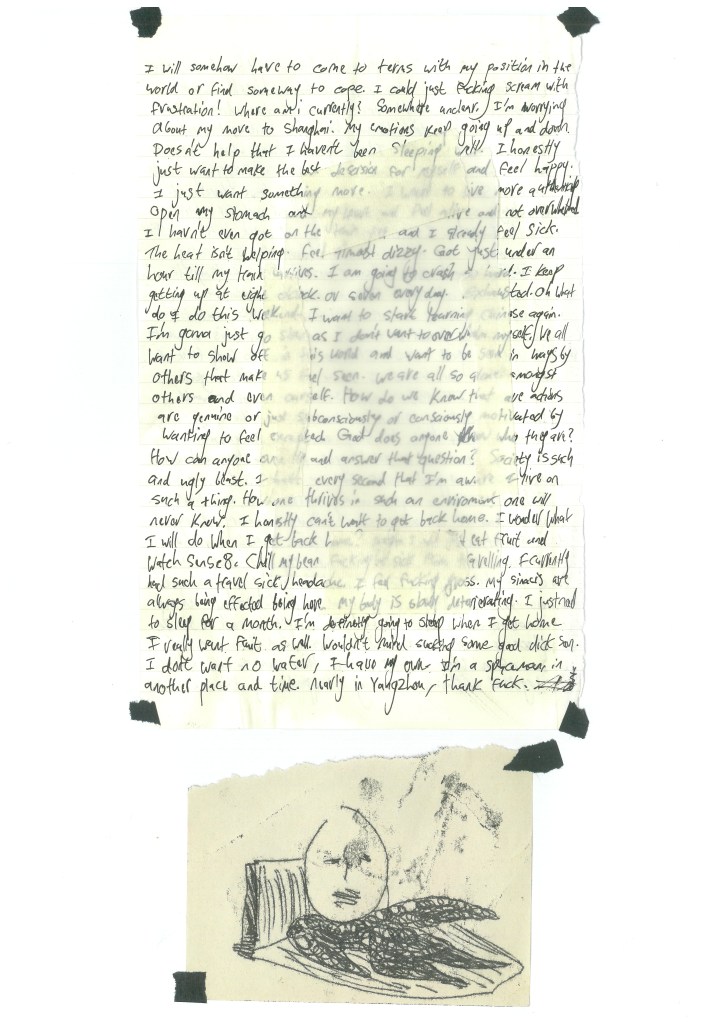
For many people, we are detached from a sense of community. We cannot share our experiences, grief, longing, desire, or trauma. We may share a sliver of this information with a close friend but they may not be able to fully empathize with our experience. We often have no release or space for our voices to be shared. I propose that drawing is this dedicated space where we can whisper, shout, scream, and talk.
Drawing allows us to communicate through shapes, textures, lines, colors, and symbols. Words are often futile devices when materializing and navigating through the labyrinth of our inner worlds and emotional depths.
How can we really materialize a definitive image of self?
For many years I have been exploring notions of memory, grief, and Queerhood within my work. I believe that there is a connection between drawing and the human condition. We are able to obtain a unique form of Intimacy through drawing. Drawing presents a space with endless possibilities, and no set boundaries, which often as Queer people we need and long for in our day-to-day lives. A space where anything is possible.
Drawing provides spaces of exploration hidden from shame.
“I AM NAKED IN PAPER, CAGED IN FLESH”
“Why does the Queer bird sing?”
I am often influenced by my day-to-day life and past experiences as a Queer person. I often explore unconscious spaces in order to confront and discover new forms of my identity.
My experiences and memories are often fragmented due to the nature of memory. I believe memory is often obscured and fragmented through our own biases, observations, and experiences.
Memory mutates. It is always in a state of flux.
If memory mutates, then so too should our Queer identities and the experiences that shape them. This suggests that we have layers and evolutions of Queer identities within our subconscious.
Ideas, dreams, desires, and memories combine and shape into new forms. Some may argue that dreams are cultivated in a similar way. The objective of my practice is to extract memories and fragments of my identity from subconscious spaces to understand and process my Queer experience.
Drawing allows me to dissect these fragments of memory and capture “phantom identities.” A term I often refer to is previous husks of Queer development stages. Drawing can be an attempt to ground and materialize intangible selves.
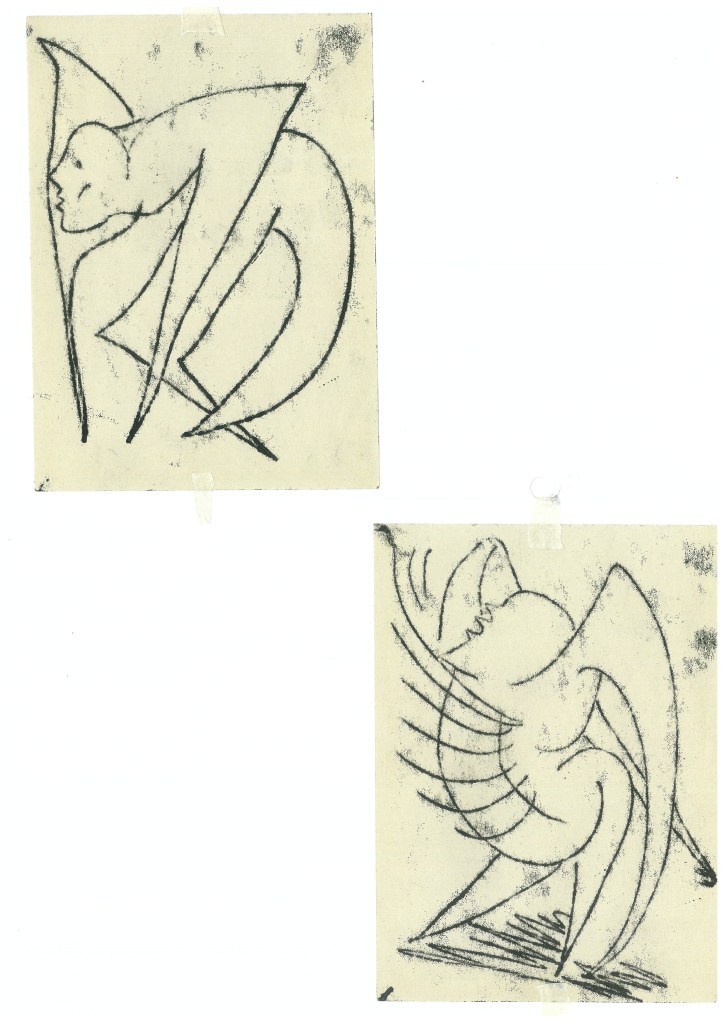
My attempts consist mainly of automatic drawing and sculpture. “Automatism” refers to the surrealist technique of an artist or writer performing actions without conscious thought. We can refer to some processes as “automatic drawing” or “automatic writing.” These processes dominate my practice as they allow subconscious approaches to work and open new entries of thought.
Draw three lines on a piece of paper.
Attempt to fill these blank spaces. Do not think. Just act.
The Queer subconscious is a resource of unprocessed and intangible honesty for me. I see the subconscious as a labyrinth with many doors, windows, and intersections of experience and identities. As a Queer person, I want to confront many aspects of my Queerhood and identity to ultimately understand who I was, who I am, where I am going, and who will I become.
We should understand that our experiences and identities are valid. Both positive and negative experiences shape our humanity, for better or worse. The subconscious allows us to extract hidden messages and explore inner worlds.
Drawing can present a tool for us to cultivate such space, a space to process, create, construct, deconstruct, cry, scream, die, regain, and discard.
Drawing allows our humanity, our Queerness, and the human condition to be expressed as a space where we alone reside when we are unable to contact or reach the outer world.
Drawing allows us to be vulnerable and explore our Queerness to reach new depths of identity and allows us to find a place in a harsh and jaded world. We may find hidden meaning within the process although sometimes it can further expand the meaning of our own identities, expanding a wider message that evolves from the self.
Slip through the cracks
Plant a seed within the tomb
Cry a storm
Cultivate a garden
Burn down the home
Bend the bars
Breathe the breath that is yours
Follow the hands that lay empty
Discover sand on untouched shores
Whisper a word
Swallow an ocean
Hair upon the skin
Pink
Red
Yellow
Blue
Green
Find beauty
Love
Forget
Forget
Forgive
Photos: Courtesy of Kerry Challis Thomas

About the Author
Kerry Challis Thomas is a Welsh artist based in Beijing. His work explores notions of Queerness and Queerhood through memory. Challis attempts to explore the nature of memory and its contribution to our constructed identities. The themes of power, grief, Queerness, and the abject are present through Challis’ mixed media practice.
 Piquing Duck
3 thoughts on “Fine Lines: Explorations of queerhood through drawing”