Throughout history, India has consistently proven itself as an arts and culture powerhouse. Long before British rule, Indian silks were hailed as far as the Middle East and China for being as light as air, while Indian sculptors and painters of old, left behind creations that continue to dazzle art lovers to this day. Contemporary Indian artists themselves have kept up the noble traditions of art in the country, gaining critical acclaim the world over. However, not until recent years have Queer creators been credited for their contributions to the tour de force that is the Indian art scene. From movies to literature, to fashion and architecture, sexual minorities’ contributions to the advancement of art movements in the country have been overlooked, or overshadowed by the legacy of the remnants of colonial-era laws that criminalized their existence.
The scrapping of part of Section 377A of the Indian Penal Code expressly prohibiting homosexuality in September 2018 heralded an era of change. Now, Queer artists, partly thanks to social media, are free to openly express their sexuality without fear of what it might mean for their careers. However, long before the decriminalization of homosexuality, revolutionary artists were producing revolutionary, critically acclaimed works that sparked conversations about LGBTQIA+ rights in the country and humanized their struggles. Author Ramachandrapurapu Raj Rao, for instance, whose novel The Boyfriend was one of the first such novels to be published in India, and whose BOMGaY poem collection would be the basis of the movie Bomgay.
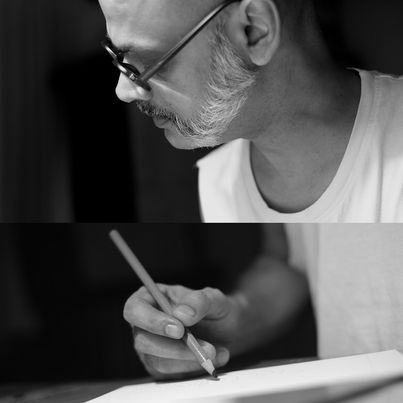
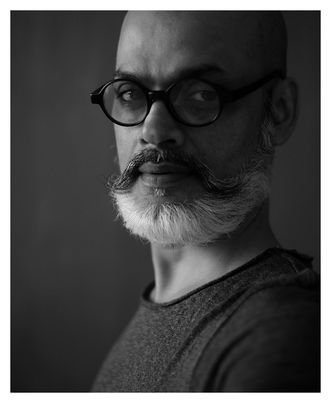
It was in this climate of secrecy and precarity that Goa-based artist, painter, and photographer Alok Johri came of age, testing the bounds of freedom, self-expression, authenticity in his chosen art medium, and honesty about who he was. After betting on the truth and revealing his sexuality to his family back when there was barely a glimmer of hope of the repealing of India’s anti-homosexual law, Johri won acceptance from his family, but it has not been smooth sailing, neither in his personal nor professional life, as he explains.
When did you realize you were Queer/ Gay, and how did you initially deal with that realization?
At the age of eight or nine, I told my mother “I wish I was born a girl.” I didn’t know the term “gay” then.
I went to an all-boys high school from grade six onward and that’s when I realized I only liked boys without knowing or having an understanding of sexual attraction. This was in the early 80s but there never was any self-doubt about my attraction for boys; no denial. Instead, I found it awkward even witnessing boys teasing girls. Until then, I had created my own world within my head.
As a young person coming to terms with your sexuality in a country that, at the time, criminalized Homosexuality, what were your initial concerns and worries and how did you manage them?
I think those of us who grew up in the ‘80s and ‘90s and came from a middle-class upbringing, were raised in a culture in which maintaining the status quo was ingrained in us. In smaller cities and towns, no one talked about these issues openly or even at all. Fear of shame must have been bigger than any other fear for a Queer person. I think in my case; art was my escape into a world unknown to others around. Socially you just had to be so-called “straight acting.” They say if you lie long enough it turns into truth, truth in the eyes of the world but not within. You just did not take chances and found every possible way to dodge the situation/questions people asked about your personal choices. I shifted my focus completely toward my professional career.
What is your coming out story? Who did you tell and how did you eventually gain the courage to be open and out about your sexual orientation and identity?
My coming out happened a few months after I moved to Goa at the end of 2005. Though at the time I had a few openly gay friends and/or colleagues in India and overseas through online connections, I still, for some reason, I could not bring myself to come out. Even though I was financially and socially confident, I did not feel the dire need to come out. By then I had also surpassed the phase of being pressurized into marrying a woman, of course at work and socially no one spared you without imposing their idea of marriage, but again, I stuck to my guns (no pun intended).
But one fateful morning, I received a call from a friend in Bangalore, that a friend of hers I had met over lunch in her house just before I left Bangalore for Goa, wanted to commission me for a photography assignment and I was connected to this person (woman) via email. She explained the work to me, we kept in touch and finally planned the photoshoot in Goa was underway. The work lasted for three days, and I was paid my fee without any hesitation or negotiation.
Just after I had been paid, her (the client’s) attitude toward me changed as if I did not exist. I confronted her and asked whether there was something she was not happy with about the work, and said I was willing to redo it for no extra fee, to which she assured me that everything was perfect and she loved the work.
Then what?
I then demanded that she explain her attitude toward me. I could have just ignored and moved on but I guess there was more to it. And after my being insistent on knowing what was going on in her mind, she finally confessed that she had fallen for me from the first time she met me in person over lunch in Bangalore. So this photography assignment was just an excuse to get closer to me. This time something told me, that I have to put an end to women falling for me and I asked for her trust to disclose something very personal and she assured me. When I told her “I am Gay,” her immediate response “So what?” Really?
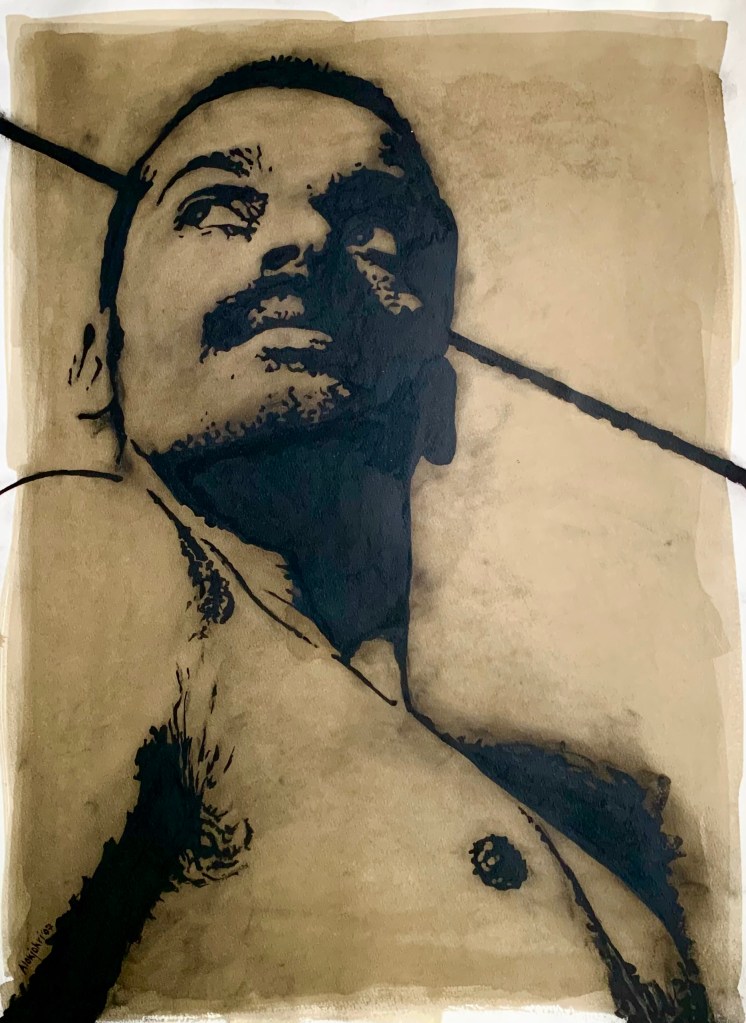
Recently, a very young man, who I have painted asked me on Instagram why do I paint/draw male Nudes? My answer was simple: “Because I don’t want the viewers to strip my subject in their heads.” And to confront any work that challenges your mindset, you need to evolve enough to confront it.
Alok Johri
I felt so sickened that she just wanted to sleep with me! She thought she was rich enough to throw money at an artist and he would succumb to her will. I was polite and said, “I am sorry, I cannot stop you from looking at me the way you do but I can assure you, I will not be able to reciprocate your feelings and meet your needs.” A day later, she turned and threatened to OUT me to all my friends in Bangalore. I felt trapped. This is when I contemplated suicide. But I did not want my family to wonder about this insane act of mine, so I decided to speak to my brother over the phone.
He is not an early morning person, and after three missed calls there was no response. I was desperate. So I called a close friend’s husband in Bombay; he was shocked to receive my call at 6.30 am and like a diva I was sobbing on the phone. He freaked out when I told him, “This is the last time you will be hearing from me.” I couldn’t bring myself to tell him the reason over the phone, and instead, I suggested writing an email and sending it. He gave me exactly three minutes to draft and send it.
Before I could press the send button on my laptop, he had already called me 11 times because I spent seven minutes deciding the opening line of my email. Finally, I pressed send, and soon after he called me back. I feared the worst. He said, “I hear that you are flying to London for work. Please change your return tick to Bombay and we throw a ‘Johri’s coming out party’ and then you can kill yourself.” I immediately dropped the idea of killing myself.
Two days later, I left for London, and while there my clients (a couple) saw my face when they came to pick me up and asked what had happened to which I replied that I had just come out to my friends. They said that it was a reason to celebrate and the next day they encouraged me to tell my siblings, and even though I had misgivings, I did My elder brother, in response said, “If you are expecting me to treat you differently just because you are gay, forget it!” And my sister wrote a long lecture-like email asking why I took so long and why I cared about what the world thought in the first place. On my return to India a few weeks later, my Sister visited me in Goa for the first time and the first thing she asked me in the car was, “Do you have a boyfriend?”
I was dating someone long-distance; I had met him in Hyderabad a couple of times but he had never been to Goa. My sister hounded me to get him to Goa for the long weekend so she could meet him, and so they did after which I was sidelined. He and I broke up soon after this trip, but she and he are still friends. Then in another month or two, I came out to all the people who really mattered to me – close friends and most preciously my students in Bangalore. I felt so stupid having wasted so many years hiding myself. But soon I decided to thank that woman in my heart for having put me in that situation that almost pushed me to the edge. It was a blessing in disguise.
Read More:
- Slow Start: Japan’s Watered-down LGBTQ Understanding Bill a Step in the Right Direction
- So, Uhm…: Voicing the Crushing Silence of Depression
- Brick by Brick – Scholar Dismantling Misconcemtpions about Queer China
In your process of self-discovery and self-acceptance, how did your initial realization regarding your sexuality affect your interaction with art and your evolution as an artist?
One thing I realized during my art college days was that “art reveals and heals everything.” That stuck with me and I held onto it. Struggling to strike a balance between what to reveal and conceal seemed challenging but then I also learned about the whole idea of “creative freedom.” I knew artists could be the best tricksters or liars and manipulative creatures, so I used all this to my own advantage without harming anyone, but of course, art doesn’t hurt anyone but heals. This is how I see myself growing in art; there’s no end to challenges in life, you overcome one, and new ones surface and you go on painting.
What were your initial influences i.e. people, places, or styles that helped you evolve your unique artistic style?
Right from the beginning I didn’t want to conform to any particular school of thought or genre. Instead, I was open to absorbing everything around me and going as far as possible in search of exposure, be it through people, books, and then, of course, the internet revolution opened the floodgates.
Living long years of a dual life, heteronormative for the world outside and still holding on to the true self within, reinforced the idea of not sticking to a particular style or school of thought, which allowed me to be experimental and fearless in my approach to work. It is in the last 15-odd years post coming out that I feel there’s only one Alok who is a work in progress and I guess that seems to be reflected in my work.
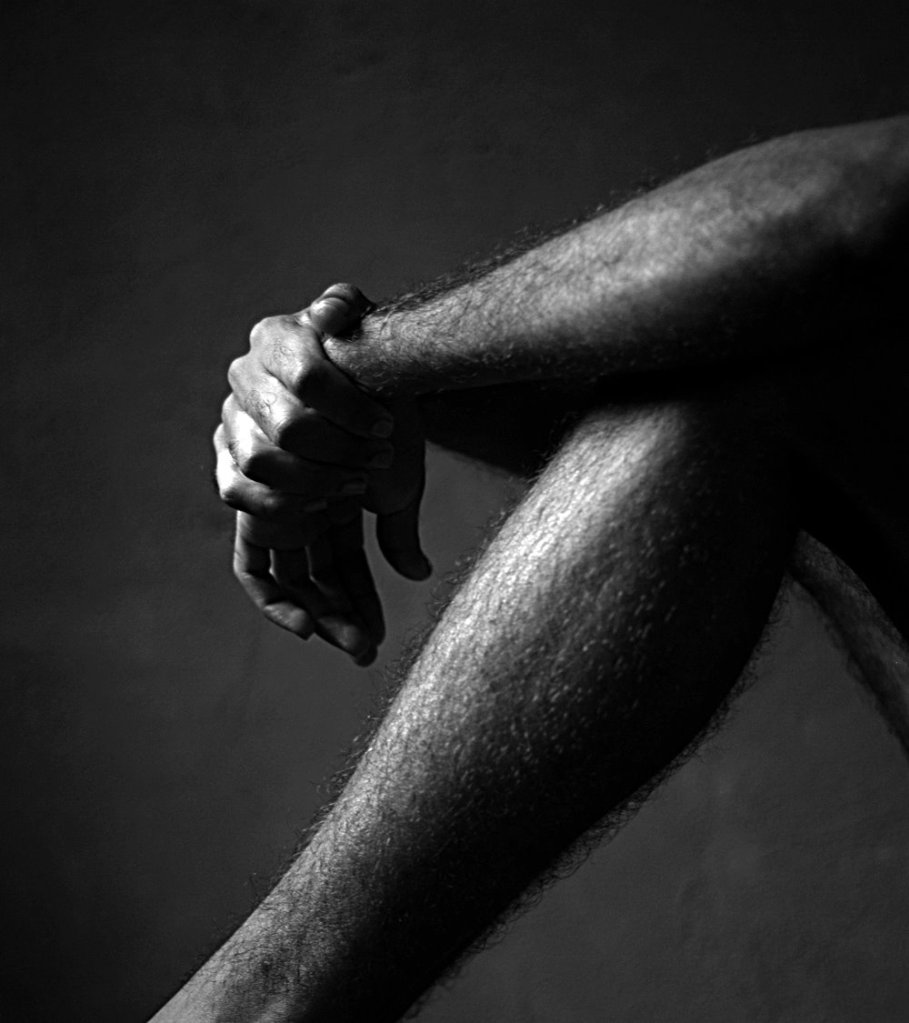
Your artistic works are quite sensual and homoerotic. Has it always been like this and if not, what inspired you to make the transition to painting the male form in such a sensual, honest, and erotic way?
I think it is also a reflection of my getting comfortable in my own skin. It’s a natural process to embrace yourself and subtly efface all the stigma attached to nudity as a form of art in general. I know it challenges the idea of masculinity and makes men seem vulnerable but to embrace both masculine and feminine sides is a balanced way to be.
Recently, a very young man, who I have painted asked me on Instagram why do I paint/draw male Nudes? My answer was simple: “Because I don’t want the viewers to strip my subject in their heads.” And to confront any work that challenges your mindset, you need to evolve enough to confront it.
As an artist and a semi-public figure, are there times when your sexuality has been an issue or a hindrance to pursuing artistic projects, landing commissions, or having your work showcased?
I keep myself updated on the social/political scene and tread my path without compromising my work. There are times when galleries were hesitant to showcase my work fearing some social/political brickbats but I did manage to convince some of them and the showcases went ahead, and surprisingly the work was well received. I feel when your intentions are not to provoke or seek attention but only to become known, people can see that the purpose is different and they hold themselves back and give themselves time to respond rather than react. But that does not mean challenges are not there. There are some well-known galleries in India that are keen to showcase my work but are not confident yet, but hopefully someday soon (that will change). And I have been extremely fortunate to have some loyal and new collectors of my work, both in India and in Europe.

Do you have any links to any sexual and gender rights activist groups in India? How profound has their impact been since Section 377 of the Indian Penal Code was repealed?
I am not directly involved with any particular group or organization but I do support their work and whenever possible, I do participate through my work when they organize any queer art shows. I am more than happy to contribute. Well, Section 377 was struck down because of some of these Gay/Queer rights organizations and Individuals who just refused to give up. I also feel the youth in India now are much more out there, and they supported these older organizations. I personally feel things are moving faster than we ever imagined, and of course, there’s a lot more work to be done.
What are some of the challenges, in your opinion, that Queer men such as yourself face both within the Queer community and from the general public?
Within the community, unfortunately, 95 percent (hypothetically speaking) of queer men around my age are married to women and have Children, so the chances of me socially interacting with them are almost zero. As far as the general public is concerned, it really hasn’t made any difference because before and after coming out I have lived the same life; nothing has changed in my social life. If at all my sense of freedom bothers anyone, they should be questioning their own lives, not mine. I feel that others intrude only when we allow them to by seeking their acceptance, for anything in life.
Are there instances in which you feared for your life or felt unsafe and wished that the government offered more protection to minorities such as yourself?
Not so far, even before Section 377 was struck down. I guess I considered myself quite fortunate to have lived and worked in an environment that was safe. Also, I did not allow myself to be in a situation in which there was no legal support for the LGBTQ community. For me, every individual is a minority.
If you wish to share, what has your experience with love and romance been like in previous times when homosexuality was criminalized?
A very intense and painful breakup to begin with, for both (me and my ex-partner). It had nothing to do with the pre/post-decriminalization of homosexuality. He unfortunately was and still is in denial about his own sexuality, and at one point I felt worn out and lost hope for this connection and decided to step back. As a friend said, “In any relationship (except your biological/immediate family) if you have to struggle to be in it, it’s not worth it.”
In your opinion, how do you think the repealing of section 377 will positively impact Indian society at large, and most especially gender and sexual minorities in the country?
We are a very diverse and complex culture. What works in one part of India may not work in another. A legal shift can bring only so much change through which those who are aware of their rights benefit from it. I feel that in any society, it’s the mindset of people that takes a few generations to show change at large. As a country, our biggest advantage is our youth, a large percentage of which amounts to a big change, especially with social media at hand. But I really hope this positive change also percolates down to smaller towns and rural India because that’s where our largest population is. I am more concerned about their safety and well-being as Queer folks.
Looking forward, what do you hope the conjunction of your sexuality and artistry will be able to accomplish in art and activist spaces not only in India but further afield?
I strive to remain as honest as possible to myself and in my work. Odds will always be around and ahead, and are there only to test my practice. If I am consistent in my practice and belief system, I am hoping it will end up inspiring someone out there.
Follow Alok Johri and his artwork below.
Photos: Courtesy of Alok Johri
 Piquing Duck
5 thoughts on “Art of Authenticity: Indian Painter and Photographer Shares His Coming Out Journey and Artistic Inspiration”