
Many predominantly Muslim countries in Asia have laws expressly limiting or outright outlawing LGBTQIA+ expression on religious grounds, upon which, if found guilty, one could face stiff penalties and harsh punishments. In Malaysia for instance, if found guilty of homosexual acts, one could face a prison sentence of up to 20 years, with caning and fines, while Muslim citizens might face additional charges in an Islamic Court under Sharia law, and foreigners may likely be deported. Two countries in the region, however, stand out – Pakistan and Bangladesh. Once part of the greater British Raj, both countries inherited the British Penal Code which expressly prohibits homosexual acts. But both countries also share a culture unique to the Indian subcontinent – a long, complex history of third-gender individuals in society.
Turning Back the Clock
Despite homosexuality being illegal, after the passing of the Transgender Persons (Protection of Rights) Act 2018, Pakistan was hailed by the International Commission of Jurists as having one of the more progressive laws on transgender rights globally. The act allowed Trans individuals in Pakistan, also known as Khwaja Sira, to choose their own gender identity as they perceive it themselves, explicitly prohibited discrimination against the said group, and allowed them to change their gender on government-issued documents. However, certain provisions of the act were struck down by the Federal Shariat Court in May, as they were declared to be in contradiction to Islam.

marriages”,19 a deliberate tactic to garner support from the general public against the Act.” – Amnesty International
While acknowledging that Islam does recognize the existence of “people born with mixed or ambiguous genitalia,” and allows for castration in exceptional cases and under the advice of a medical professional, the religion doesn’t allow for castration to change gender, nor does it permit one to choose one’s own gender. The ruling has been widely condemned by Trans rights activists in Pakistan and human rights groups in the country and internationally. The law defines a transgender person as anyone with mixed male and female genital features or ambiguous genitalia, a person assigned male at birth but who has undergone castration, or a person whose gender identity or expression differs from their assigned birth.
A statement issued by Amnesty International on May 19, a day after the ruling was announced read in part, “This verdict is a blow to the rights of the already beleaguered group of transgender and gender-diverse people in Pakistan… The denial of essential rights of transgender and gender diverse persons should not be guided by assumptions rooted in prejudice, fear, and discrimination.”
Aside from the court emphasizing that religious practices such as prayer, fasting, and Hajj are gender-based, it also framed its decision as a preemptive measure aimed at preventing gender-based crime, such as rape and assault of women, and sexual molestation as the law “makes it easy for a biological male to get access to the exclusive spaces and gatherings of females in the disguise of a ‘transgender woman’.” In response to this claim, Amnesty International also noted, “some of the observations made by the Court were based on presumptive scenarios rather than empirical evidence,” pointing out that there is no public evidence of such incidents to support such a claim by the court.
Since it was passed by the Pakistani Parliament in 2018, the Transgender Persons Act has faced opposition from clerics and legislators from the conservative wing of government led by Senator Mushtaq Ahmad Khan, a member of the conservative party Jamat-e-Islami. In an interview with VOA, Khan claimed that the law was a threat to the family system, values, and traditions, and termed it a cultural invasion. Previously, Khan had also stated he doesn’t believe that “fully male” or “fully female” persons should be given the right to self-identify according to their own gender perception, but rather “they should seek psychological help.”
Opponents also claimed that the law would open the door to same-sex marriage which is currently prohibited under Pakistani law. In September 2022, Senator Fawzia Arshad from the Pakistan Tehreek-e-Insaaf (PTI) party introduced a bill to replace the 2018 legislation, in which protections would only be extended to those with ambiguous genitalia, removing clauses that allowed for gender self-identification. In response to growing campaigns against the law passed in 2018, Pakistan’s Law Minister, Azam Nazir Tarar, said it was “baseless propaganda” to term the bill as un-Islamic.
Read More:
- Slow Start: Japan’s Watered-down LGBTQ Understanding Bill a Step in the Right Direction
- So, Uhm…: Voicing the Crushing Silence of Depression
- Brick by Brick – Scholar Dismantling Misconcemtpions about Queer China
Past Glory Days
Pakistan’s Khwaja Sira community has not always faced discrimination, and much like the Hijra of India and Bangladesh, were at one point in history considered to be an important part of society. It was, and in countries like Bangladesh still is, believed that third-gender people possess the power to bless and heal. During the Mughal Empire dating back to the 16th to 19th century, before British Indian subcontinent rule, the Khwaja Sira held prominent positions in society, as trusted and respected advisors in royal business and Mughal harems. The word Khwaja Sira itself is derived from Urdu and Farsi to denote Trans, castrated, and gender-nonconforming officials in the Mughal court.
This however changed with the advent of British rule and the introduction of the Criminal Tribes Act (CTC), which not only defined gender binaries but also effectively institutionalized the discrimination of the Khwaja Sira. The legacy of British colonization lingers on in Pakistan’s penal code under section 377 which states, “Whoever voluntarily has carnal intercourse against the order of nature with any man, woman or animal, shall be punished with imprisonment for life, or with imprisonment of either description for a term which shall not be less than two years nor more than ten years, and shall also be liable to fine.”
The Court ceased, with immediate effect, the sections deemed ‘un-Islamic’. During the delivery of the verdict, the Court speculated that the Act could pave the way for rape, and sexual assault of women as they allege the Act makes it easy for a man to gain access to “exclusive spaces” intended for women, “disguised” as a transgender woman. There is no publicly available evidence of such incidents taking place in Pakistan.
Amnesty International
In 2009, Trans rights in Pakistan saw a glimmer of hope for the marginalized community when a Supreme Court ruling allowed Trans people in the country to be identified on government-issued documents as third gender. It is important to note that though Trans allyship exists within Pakistani society, it is often framed within the Western framework of LGBTQ+. However, Khwaja Sira activists feel that being lumped in with sexual minorities not only conflates the issue but also the label Trans itself is often limiting, as they consider themselves to be a separate third gender and prefer to be recognized as such. Julie Khan, a prominent Trans rights activist in Pakistan notes, “Lesbian, gay, and bisexual are all sexual [orientations], but our being trans is a gender identity. They cannot be lumped together.”
Left to the Wolves
Persistent discrimination has also left many Khwaja Sira open to various forms of violence, including sexual, physical, and financial abuse. Oftentimes, Khwaja Siras are shunned by family and turned out to the streets where they are forced into sex work. Some also fall prey to the pernicious Guru culture in which destitute Trans and nonbinary minors are taken in by community leaders known as Gurus, and in exchange for food and shelter, they relinquish control over their finances and ability to make life decisions. Attacks against Trans individuals are also a common occurrence. In 2021, 20 Trans people were reportedly killed in Pakistan. The case of Gul Panah made the news in 2020. After being hired as a dancer at a wedding, Panah was attacked and killed by wedding attendees. She too was under a Guru as one of his chelas – a young Trans person taken on by a Guru.
The fight, however, is far from over. Activists like Nadeen Kashish, one of Pakistan’s first transgender politicians, and founder of the Shemale Association For Rights (SAFFAR), and Nisha Roa who was the first Trans woman in Pakistan to become a lawyer, continue to provide support for the community by empowering disenfranchised Trans individuals at the grassroots level and offering legal representation in cases of arrest and police abuse. Initiatives such as the launching of a sewing shop in Karachi by Trans Pride Society, also provide Trans individuals caught in the vicious cycle of sex work and destitution an opportunity to change their lives.
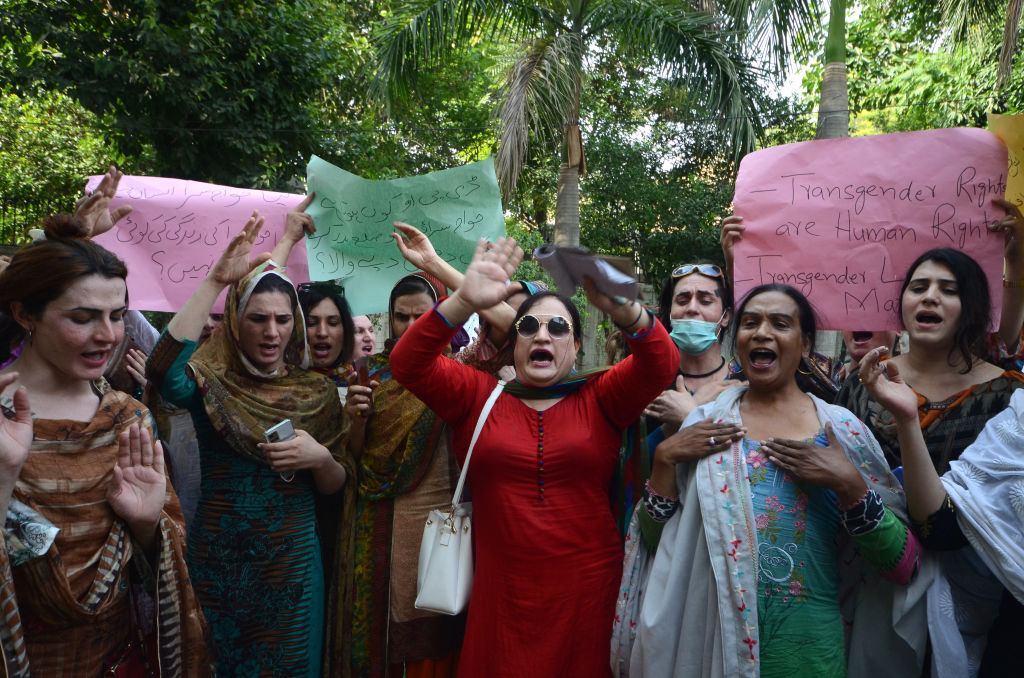
Despite the ruling by Pakistan’s Shariat Court, there is still hope for the future. As more and more Asian countries, the latest being Japan, are taking steps toward more inclusive societies, there is hope that this wind of change will blow to Pakistan and provide gender and sexual minorities in the country the much-needed relief and recognition they deserve.
Photos: Unsplash, Getty Images, Shutterstock
.
 Piquing Duck